
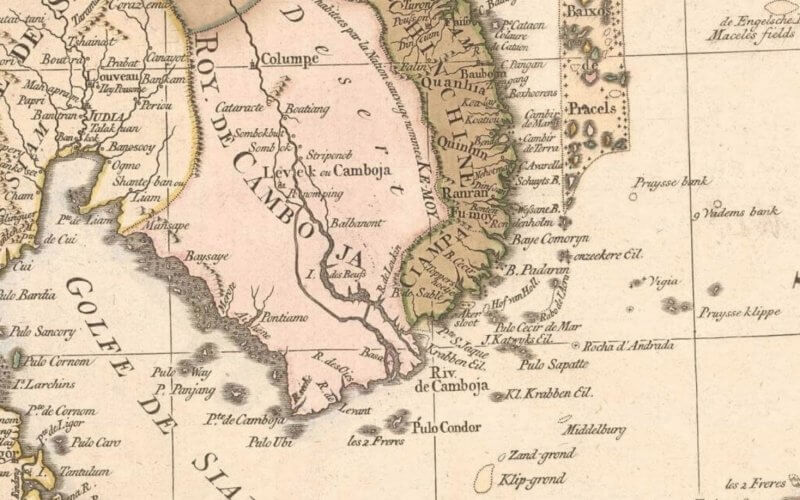
From foundational legends to the first organized kingdoms, the history of Cambodia is a fascinating blend of mythology, Indian influences, and ancient civilizations that have shaped one of the most culturally rich countries in Southeast Asia.
Between Myth and Reality : The Founding Legend
The birth of Cambodia is often told through an iconic legend. According to traditional accounts, an Indian prince named Kaundinya is said to have married a local princess, Soma, the daughter of a naga king, a mythical serpent. From their union, the first kingdom of Cambodia was born.
This story symbolizes the fusion between Indian influences and local cultures, a central element in the construction of Cambodian identity. It also marks the beginning of a civilization deeply connected to spiritual beliefs and symbols.
The Kingdom of Funan : The First Political Structures
Before the rise of Angkor, the territory of present-day Cambodia was dominated by the Kingdom of Funan, which emerged around the 1st century CE. Located in the Mekong Delta, Funan was a major trading hub connecting China, India, and the rest of Southeast Asia.
Thanks to its strategic position, the kingdom developed rapidly, adopting elements of Indian culture such as writing, Hinduism, and more structured political organization.
Chenla : The Transition Toward Territorial Power
After the decline of Funan, the Kingdom of Chenla gradually took over starting in the 6th century. Initially more fragmented, Chenla evolved into more militarized and territorial structures.
It was a period of major transformation, during which the foundations of the future Khmer Empire began to take shape. Cultural and religious influences continued to strengthen, paving the way for the emergence of an even more powerful civilization.
The Birth of the Khmer Empire
The real turning point in Cambodia’s history came in the early 9th century with the rise of Jayavarman II. In 802, he officially founded the Khmer Empire by proclaiming himself “universal monarch” on Mount Kulen.
This event symbolically marks the birth of Cambodia as a centralized state. Royal power became structured, and the construction of major temples began, announcing the future grandeur of Angkor.
Angkor : The Heart of a Civilization
The peak of this historical emergence is embodied by the city of Angkor, which became the political and spiritual center of the empire for several centuries. Its monumental temples, such as Angkor Wat, reflect the power and sophistication of Khmer civilization.
Angkor is not just a capital: it is a cosmological symbol, where royal authority is closely tied to Hindu and Buddhist beliefs.
A Living Heritage
Today, the history of Cambodia’s birth continues to live on through the country’s culture, traditions, and monuments. From founding myths to the great cities of Angkor, each layer of history tells the story of the gradual construction of a unique identity.
Understanding these origins also means gaining a deeper insight into the cultural richness of contemporary Cambodia, between ancient memory and a constantly evolving modernity.