
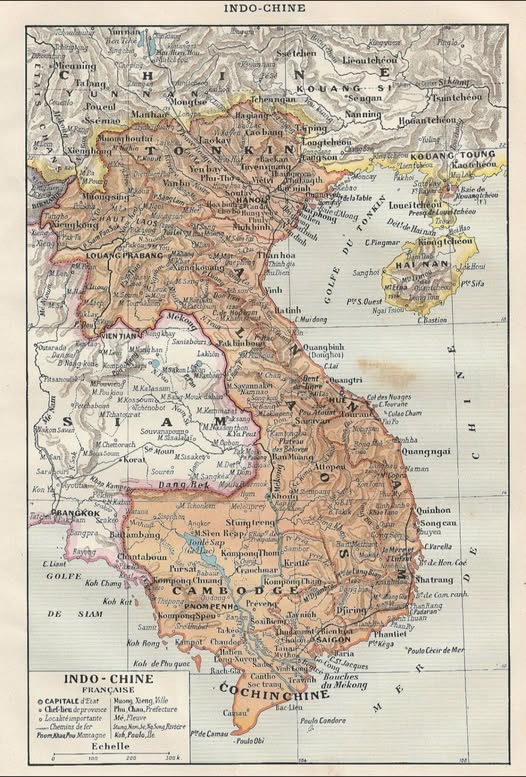
There is a date many visitors to Cambodia have never heard of, yet it helps explain much of the country they see today: 1863.
That was the year Cambodia became a French protectorate, beginning nearly nine decades of French influence that would reshape the country’s administration, cities, borders, education, architecture, and relationship with its neighbors.
From 1863 until Cambodia regained independence in 1953, the kingdom’s history was closely tied to French Indochina. The legacy of those years can still be seen today, particularly in Phnom Penh, Battambang, Kampot, and other Cambodian towns where French colonial buildings remain part of the urban landscape.
Why Did Cambodia Become a French Protectorate?
To understand French colonialism in Cambodia, it helps to look at the kingdom’s position in the nineteenth century.
The powerful Angkorian Empire had declined centuries earlier, and by the 1800s Cambodia was caught between two expanding regional powers: Siam (present-day Thailand) to the west and Vietnam to the east.
Cambodian kings faced increasing pressure from both sides.
King Norodom, who became king in 1860, sought a way to protect the kingdom’s independence and territory. At the same time, France was expanding its influence in mainland Southeast Asia after establishing control over Cochinchina in southern Vietnam.
The result was the Franco-Khmer agreement of 1863, which placed Cambodia under French protection. The arrangement allowed King Norodom to retain significant authority over internal affairs, while France gained important political and economic privileges. Cambodia’s position between Siam and Vietnam was one of the major factors behind the agreement.
From Protectorate to Colonial Administration
The original protectorate did not remain unchanged.
By the late nineteenth century, France had increasingly expanded its control over Cambodia’s administration and finances. In 1884, King Norodom signed a new agreement that significantly increased French authority over areas including taxation, customs, and administration.
In 1887, Cambodia became part of French Indochina, the wider French colonial federation in mainland Southeast Asia.
French Indochina eventually included Cambodia, Cochinchina, Annam, Tonkin, and Laos.
For Cambodia, this meant that the relationship had moved far beyond simple diplomatic protection. French officials increasingly shaped how the kingdom was governed and connected to the wider colonial economy.
How French Rule Changed Cambodia
The legacy of French colonial rule in Cambodia is complicated.
French administration introduced new systems of government and infrastructure while also placing Cambodia within a colonial economic and political system.
One important consequence was the preservation and restoration of Cambodia’s ancient monuments.
French scholars and the École française d’Extrême-Orient (EFEO) played an important role in documenting and restoring Angkor during the colonial period. Their work contributed to the preservation of monuments that later became central to Cambodia’s cultural heritage and tourism.
At the same time, colonial rule brought significant restrictions and inequalities.
Economic opportunities were heavily influenced by the colonial system, taxation placed pressure on rural communities, and access to modern education remained limited for much of the Cambodian population.
The result was a period of major institutional change, but not one in which political and economic power was equally shared.
French Influence on Cambodian Cities
You can still see traces of the colonial period when walking through Cambodia today.
Phnom Penh is perhaps the clearest example. French-era buildings, administrative structures, villas, markets, boulevards, and urban planning helped shape parts of the capital.
The influence can also be seen in cities such as Battambang, where French colonial architecture remains an important part of the old town.
Even everyday details can carry traces of the period, from architecture and food to administrative traditions and the layout of older urban neighborhoods.
This is one reason understanding Cambodia’s French colonial history can make traveling through the country’s cities more interesting. The buildings are not simply old architecture; they are reminders of a period that changed how Cambodia was organized and connected to the outside world.
Cambodia During World War II
The Second World War disrupted French colonial rule in Cambodia.
Japan occupied much of Southeast Asia, while the French administration in Indochina continued under the Vichy French government for part of the war.
In 1945, Cambodia briefly declared independence as Japanese control weakened. However, French authority was restored after the war.
The experience strengthened the movement toward genuine Cambodian independence.
Cambodia’s Road to Independence
The final chapter of French rule is closely associated with King Norodom Sihanouk.
Sihanouk became king in 1941, at a time when Cambodia was still under French colonial rule. After the Second World War, he increasingly pushed for greater Cambodian autonomy and eventually full independence.
His campaign became known as the “Royal Crusade for Independence.”
Through diplomacy, international travel, and negotiations with France, Sihanouk pressed for the end of French colonial authority.
On 9 November 1953, Cambodia regained its independence.
The date remains one of the most important dates in modern Cambodian history and is commemorated annually as Independence Day.
The Legacy of French Colonialism in Cambodia
More than seven decades after independence, the French colonial period remains visible across Cambodia.
You can find its legacy in:
- French colonial architecture
- Urban planning and historic city centers
- Administrative institutions
- Education and cultural institutions
- Cambodian cuisine and French culinary influence
- Historic roads and public buildings
- The preservation and study of Angkor
- Cambodia’s modern relationship with France
But the colonial period cannot be reduced to architecture or European influence. It was also a period of unequal political and economic power, taxation, and limited access to education for much of the population.
Understanding both sides of this history gives travelers a more complete picture of modern Cambodia.
Why This History Matters When You Travel in Cambodia
When you walk through Phnom Penh or Battambang, it is easy to see old buildings simply as beautiful reminders of another era.
Knowing the history behind them changes the way you see them.
A colonial-era building can tell you about French administration. A street layout can reveal how a city developed during the colonial period. A restaurant serving French-influenced food can be part of a much longer cultural exchange.
And when you visit Angkor, you are not only looking at the remains of an ancient Khmer civilization. You are also seeing monuments that passed through centuries of decline, rediscovery, documentation, and restoration.
Cambodia’s history did not stop with Angkor. The 90 years of French colonial rule, followed by independence in 1953, form another important chapter in understanding the country travelers experience today.
For anyone exploring Cambodia beyond the temples, learning a little about the French protectorate in Cambodia offers another way to understand its cities, architecture, culture, and modern identity.